Lo Shu grid missing numbers: what they mean, and remedies that cost nothing
Quick answer
A missing number in your Lo Shu grid is a digit from 1 to 9 that does not appear in your birth date, with your driver and conductor numbers added. Tradition reads it as a quality you build on purpose rather than one that comes naturally. Missing numbers are normal: in the 27,759 dates we tested from 1950 to 2025, not one had all nine digits. A remedy can be a small daily habit, and none needs stones, metals or money.
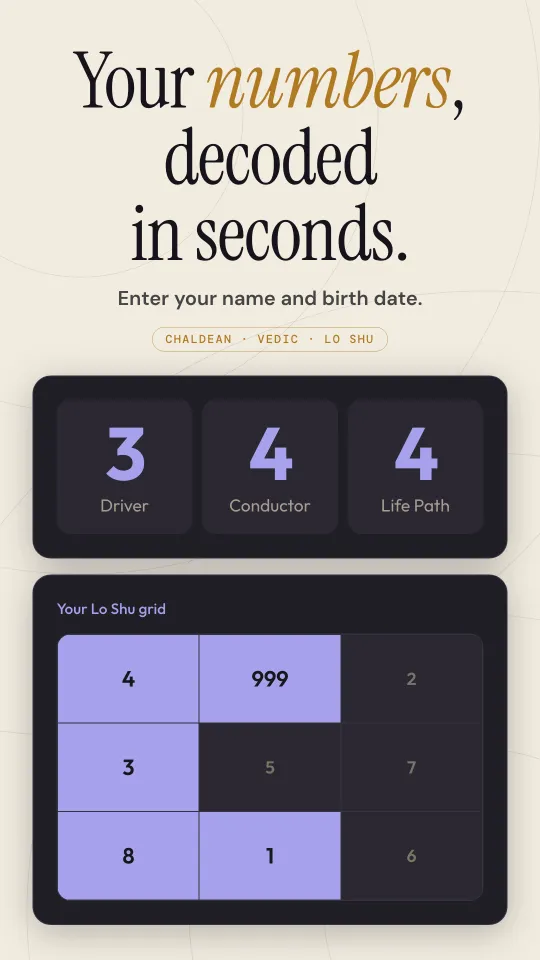
How to build your Lo Shu grid
The Lo Shu is a three-by-three square with the digits 1 to 9 in a fixed order.
| 4 | 9 | 2 |
|---|---|---|
| 3 | 5 | 7 |
| 8 | 1 | 6 |
To fill it for yourself:
- Write the digits of your birth day, month and year. Count every one.
- Add your conductor (bhagyank). It is your whole date reduced to one digit.
- Add your driver (mulank) if your birth day has two digits. The exceptions are the 10th, 20th and 30th, where the day already carries it. The 31st adds a 4.
- Put each digit in its cell, repeated as many times as it appears. A digit that never appears is missing.
If you want the two numbers worked out first, they are in our guide to mulank, bhagyank and life path.
A worked example: 14 March 1992
The date gives the digits 1, 4, 3, 1, 9, 9, 2. The conductor is 2, and the 14th has two digits, so the driver, 1 + 4 = 5, is added too.
Counting: 1 appears twice, 2 twice, 9 twice, and 3, 4 and 5 once each. Now the grid.
| 4 | 99 | 22 |
|---|---|---|
| 3 | 5 | missing |
| missing | 11 | missing |
The missing numbers are 6, 7 and 8. We ran this date through the same function NumeroGyan uses.
Missing numbers are normal
Fear around missing numbers is mostly a misunderstanding. We ran the grid for every date from 1950 to 2025, 27,759 dates in all. Not one had all nine digits.
| Born | Average missing | Never missing | Most often missing |
|---|---|---|---|
| 1950 to 1999 | 3.5 | 1 and 9 | 4 (60% of dates), 3 (58%) |
| 2000 to 2025 | 4.5 | 2 | 6, 7, 8 and 9 (63% each) |
The pattern comes from the year. Every year in the 1900s contains a 1 and a 9, so those two are never missing. Every year in the 2000s contains a 2. That is why a missing 9 is often generational rather than personal, and why a missing 1, almost impossible for anyone born in the 1900s, appears in about 18% of dates since 2000.
A missing number is a way of seeing what you do not do automatically. It is not a diagnosis.
What each missing number asks of you
Each one is read as a skill to practise. Here is a one-line version and a free habit for each.
- No 1. Putting yourself forward takes effort. Make something of your own each week and show it to one person.
- No 2. Intuition and patience are learned, not automatic. Pause for a breath before you answer, and ask one more question before you decide.
- No 3. Confidence and self-expression grow with use. Say one idea out loud in every meeting, even half formed.
- No 4. Routine and organisation do not come by themselves. Fix one wake-up time and write one plan for the week.
- No 5. Focus and adapting to change take extra effort. A missing 5 is very common. Finish one goal before you start the next.
- No 6. Giving to yourself as freely as you give to others. Tell someone close one thing you feel or need, once a week.
- No 7. Quiet reflection and inner order. Spend fifteen minutes a day alone with no screen.
- No 8. Steady money habits and follow-through. Write down what you spend for a month, and finish what you start.
- No 9. Attention to other people and the bigger picture. Do one small act of service a week.
For our example, 6, 7 and 8, the habits ask for openness about feelings, time alone and a simple money record. Whether any of it fits you is for you to judge.
Planes: the lines in the grid
The grid contains eight lines of three cells, and each is called a plane. When all three digits of a line are present, the plane is complete.
| Digits | Plane | Reads across the grid as |
|---|---|---|
| 4-9-2 | Mental | top row |
| 3-5-7 | Emotional | middle row |
| 8-1-6 | Business | bottom row |
| 4-3-8 | Thought | left column |
| 9-5-1 | Will | middle column |
| 2-7-6 | Action | right column |
| 4-5-6 | Golden | one diagonal |
| 2-5-8 | Property | the other diagonal |
In our example, 4, 9 and 2 are all present, so the Mental plane is complete. So are 9, 5 and 1, for the Will plane. The other six need a digit that is missing.
Where Kua comes in
NumeroGyan adds one more number to the grid in a particular case. Kua is a Feng Shui number worked out from your birth year and gender, counted from the solar new year, which falls around 4 February. If it is missing from your grid, and adding it would complete at least one more plane, it is added.
For 14 March 1992, a male Kua of 8 is added, completing the Property plane (2-5-8) and the Thought plane (4-3-8). A female Kua of 7 is added instead, completing the Emotional plane (3-5-7). When no gender is given, there is no Kua.
This is one of the places where sites differ. Some build the grid from the digits of the date alone, others add the driver and conductor, and others add Kua too. If your missing numbers differ from another site’s, check which digits it counted.
Remedies that cost nothing
Traditional remedy lists mix several things: colours, directions in the house, gemstones, metal chimes, yantras, charity and habits. Some of those cost money, and none is proven. A remedy is a nudge, not a transaction, so start with the ones that are free.
- Practise the missing quality in the one-line habits above. That is the point of the remedy.
- Keep your home and your surroundings tidy. A traditional suggestion for a missing 4, and sensible anyway.
- Respect the people around you. Traditions pair this with several numbers: elders and teachers with 3, the women in your life with 6, and people whose labour you depend on with 8.
- Wear light colours for a missing 7. It costs nothing if they are already in your wardrobe.
- Look after a stray animal for a missing 7, if you are able to.
- Keep Saturdays simple for a missing 8, with a lighter meal or a short fast, if that suits your health.
Never buy something because a seller says your grid demands it. If a remedy is a stone, a metal ornament or a ritual with a price, it is optional, and your grid is no worse without it.
A limit worth stating
The Lo Shu grid is a tradition for reflecting on yourself, not a test. Nothing about a missing number says what will happen in your life, and nothing here is advice on health or money.
Questions people ask
What does a missing number in the Lo Shu grid mean?
It is a digit from 1 to 9 that does not appear in your grid. In numerology it is read as a quality you develop deliberately, not as a defect or a fate.
Is it bad to have missing numbers?
No. Everyone has some. Across the dates we tested from 1950 to 2025, none had all nine digits, and the average grid was missing between three and five.
How do I make my Lo Shu grid?
Write down the digits of your day, month and year, add your conductor number, and add your driver number if your birth day has two digits (except the 10th, 20th and 30th). Place each digit in the grid, and count how many times it appears.
Why do people born after 2000 often miss a 9?
Years in the 1900s contain a 9, so those birth dates never miss it. Years from 2000 do not, so a missing 9 depends on the rest of the date. It is generational more than personal.
Do I need to buy a stone or a metal remedy?
No. Traditional lists include gemstones, metal chimes and yantras, but a daily habit that builds the missing quality is just as relevant, and it costs nothing.
Can I fix a missing number by changing my mobile number or name?
Not literally. Some writers suggest including the digit in your phone number or house number as a light reminder, and others say a phone number does not change your grid at all. Treat it, at most, as a small prompt.
Numerology is a traditional belief system. NumeroGyan is for reflection and entertainment, not professional medical, financial, legal or psychological advice.