Numerology guides and calculators
Quick answer
Numerology turns your birth date and name into a few numbers, each one read as a theme: your Driver (mulank) from your birth day, your Conductor (bhagyank) from your full date, a life path number, a name number and the Lo Shu grid. These guides show how each is calculated, with worked examples, and where traditions disagree. It is a way to reflect, not a forecast or advice.
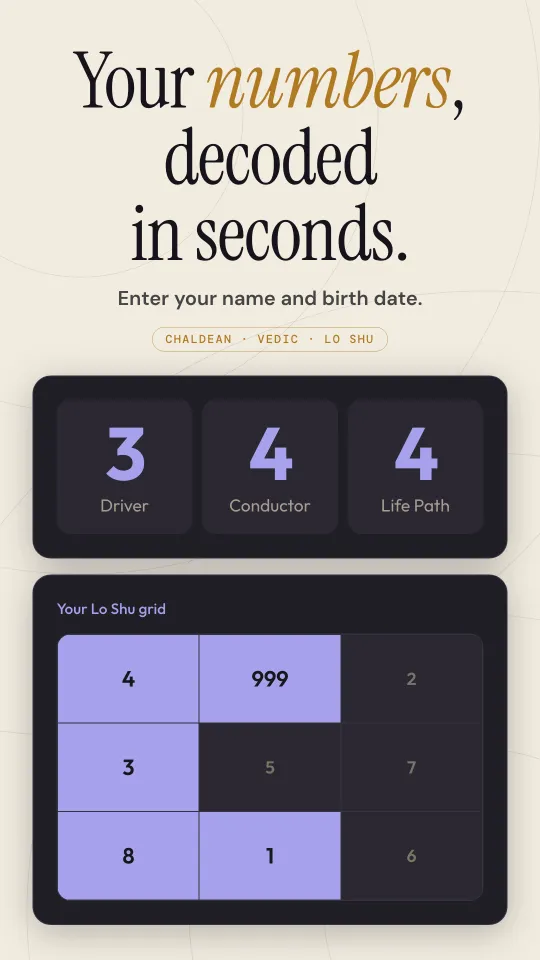
The numbers
Everything in numerology starts from two things you already have: a date of birth and a name. These are the numbers the guides on this site explain.
- Driver (mulank): your birth day reduced to one digit. 14 becomes 1 + 4 = 5.
- Conductor (bhagyank): your full date of birth, added up and reduced. It describes the direction a life takes.
- Life path: the same digits as the conductor, except that it keeps the master numbers 11, 22 and 33 instead of reducing them.
- Name number: the letters of your name, turned into numbers on the Chaldean table and added up.
- Lo Shu grid: a three-by-three square of the digits in your birth date. The gaps are read as missing qualities.
- Personal year: your birth month and day plus the digits of the year, reduced. It repeats on a nine-year cycle.
Where traditions disagree
They disagree more than most guides admit. Whether 11, 22 and 33 are kept or reduced, whether the personal year starts on 1 January or on your birthday, and whether a mobile number is judged for everyone or only for you: all of these have more than one answer in print. These guides say which choice NumeroGyan makes and why, so you can compare the number you get with the one on any other site.
Start here
- Personal year 2027: a three-step sum and a lookup table, and what each of the nine years asks of you.
- Mulank, bhagyank and life path: the three birth numbers, and why two sites can give you different answers.
- Lucky mobile number by date of birth: how a number is judged against your birth numbers, and why the “avoid 4 and 8” lists contradict each other.
- How to check if your name is lucky: the Chaldean table, the Y rule and a worked name.
- Should you change your name spelling?: the cheapest change first, and why to leave your documents alone.
- Baby name numerology: checking a shortlist against a birth date.
- Lo Shu grid missing numbers: build your grid, and remedies that cost nothing.
- Why numerology calculators give different numbers: six reasons, with examples.
A note on how to use these
Numerology works best as a prompt for questions you would like to ask yourself, such as what you are building this year or what a name means to you. It does not predict events, and it is not advice about health, money, marriage or law.
Questions people ask
Is numerology scientifically proven?
No. Numerology is a traditional belief system with no scientific support. NumeroGyan treats it as a tool for reflection and entertainment, and these guides do the same.
What is the difference between mulank and bhagyank?
Mulank is the Driver number, taken from your birth day alone. Bhagyank is the Conductor number, taken from your full date of birth.
Which numerology system does NumeroGyan use?
Chaldean letter values for names, with Vedic and Lo Shu readings for the birth-date numbers. It does not use the Pythagorean system.
Is NumeroGyan free?
It is free to start. Some tools cost coins, and Pro is an optional subscription. The app also shows ads.
Numerology is a traditional belief system. NumeroGyan is for reflection and entertainment, not professional medical, financial, legal or psychological advice.