Baby name numerology: how to check a name against the birth date
Quick answer
Work out the baby's mulank and bhagyank from the birth date. Then add up each name on your shortlist with the Chaldean table and compare its number with both. A name whose number gets on with both is a fit, and the two-digit total before reducing adds a second note. One letter can change the answer: for a baby born on 23 June 2026, Arav rates excellent, while Aarav and Aaraav do not. Shortlist the names your family loves first, then use the numbers as a tiebreaker.
Four steps
- Get the birth date. The fit is calculated against it, so the date comes first. If the baby has not arrived yet, you can prepare a shortlist, but the numbers mean something only once the date is known.
- Work out the baby’s mulank and bhagyank. Mulank comes from the day of birth, and bhagyank from the whole date. We show how in our guide to the three birth numbers.
- Add up each name. Give every letter its Chaldean value, add them, and reduce to one digit. The table and the Y rule are in our name number guide.
- Compare. A name number that gets on with both birth numbers is a fit. Then look at the two-digit total, the compound, for a second note.
A worked example
Take an imaginary baby born on 23 June 2026.
- Mulank: 2 + 3 = 5.
- Bhagyank: 2 + 3 + 6 + 2 + 0 + 2 + 6 = 21, then 2 + 1 = 3.
Now a shortlist of names, rated by the same function NumeroGyan uses.
| Name | Total | Root | Note | Rating |
|---|---|---|---|---|
| Arav | 10 | 1 | kind | Excellent |
| Aarav | 11 | 2 | caution | Not rec. |
| Aaraav | 12 | 3 | caution | Not rec. |
| Vihaan | 19 | 1 | kind | Excellent |
| Kabir | 8 | 8 | none | Excellent |
| Anaya | 9 | 9 | none | Excellent |
| Ishaan | 16 | 7 | caution | Not rec. |
| Reyansh | 22 | 4 | caution | Not rec. |
Total is the sum of the Chaldean letter values, and Root is that total reduced to one digit. Note is the compound note: “kind” means a favourable compound and “caution” a cautioned one. “Not rec.” is the app’s “not recommended”. For the first three names, the sums by hand are Arav 1 + 2 + 1 + 6 = 10, Aarav 1 + 1 + 2 + 1 + 6 = 11 and Aaraav 1 + 1 + 2 + 1 + 1 + 6 = 12.
Look at the first three rows. Arav, Aarav and Aaraav sound almost alike, and they differ by a single letter each. Arav totals 10, a favourable compound. Add one letter and Aarav totals 11, a cautioned compound. Add another and Aaraav totals 12, also cautioned.
Look also at the root. A baby with a mulank of 5 and a bhagyank of 3 has friendly relations with nearly every name number, so the root hardly separates these names at all. The compound does. That is a good example of why it helps to read both.
What the compound note means
The compound is the two-digit total before the final reduction. Cheiro’s Book of Numbers, published in 1926, gives readings to the compounds from 10 to 52. Two short lists are what a name check uses.
- Favourable compounds: 10, 14, 15, 19, 21, 23, 24, 27, 32 and 37.
- Cautioned compounds: 11, 12, 13, 16, 18, 22, 26, 28, 29, 43, 44 and 52.
Most totals are on neither list, and a name that lands on neither is simply read by its root. A compound never overrides the root. If the root clashes with the birth numbers, a favourable compound does not rescue it.
Two honest notes. First, these readings belong to one tradition, and other schools read the same numbers differently. Second, a caution is a warning in that tradition, not a prediction, and plenty of families name a baby something that carries one. If you love a name with a cautioned total, a small spelling change that keeps the pronunciation is the usual answer, as our guide to changing a name spelling explains.
How to use this without losing the plot
- Start with the names your family loves. Use the numbers to choose between them, not to find names you do not like.
- Check a few spellings of the same name. If the sound is right and a variant fits better, the variant costs nothing.
- Think about the whole life of the name. It will be spelled out on forms, called across playgrounds and written on certificates for decades. Meaning, sound, heritage and ease of pronunciation matter more than a number.
- Treat a cautioned compound as a prompt to look at alternatives, not a verdict.
Numerology is a tradition, not a science. Nothing here predicts how a child will do in life, and no name will change that.
Doing it faster
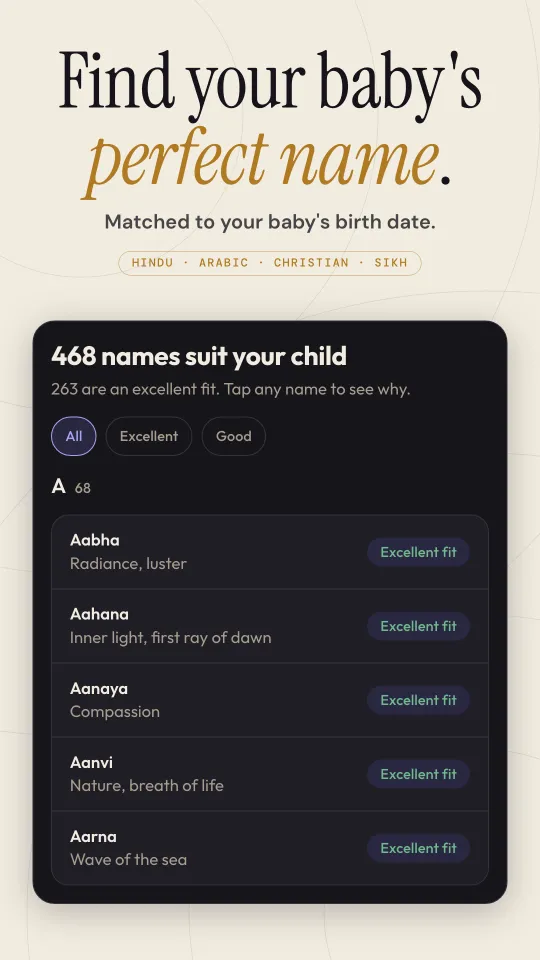
Working through a long list by hand is slow. NumeroGyan’s Name Selection takes a birth date, a gender and a choice of Hindu, Arabic, Christian or Sikh names, and scores that list against the date. It runs on coins, and the method on this page is the same one it uses.
Questions people ask
How do I check a baby name with numerology?
Find the baby's mulank and bhagyank from the birth date. Add the Chaldean values of the letters in each candidate name, reduce to one digit, and see whether that number gets on with both birth numbers.
Which name system is used for baby names?
NumeroGyan uses the Chaldean letter table throughout, with compound numbers read from Cheiro's Book of Numbers.
Does the spelling of a baby name matter?
Yes. Adding or removing a letter changes the total, and so can change the number. Arav, Aarav and Aaraav sound alike and add up to 10, 11 and 12.
Can I check a name before the baby is born?
You can add up a shortlist beforehand, but the fit depends on the birth date, so the result only means something once the date is known.
What if we love a name that does not fit?
Try a spelling variant that keeps the pronunciation. If nothing fits, name the baby the name you love. A number is a tiebreaker, not a reason to give up a name that matters to your family.
Is baby name numerology scientifically proven?
No. It is a tradition, and it should be one consideration among several, such as meaning, sound and family heritage.
Sources
Numerology is a traditional belief system. NumeroGyan is for reflection and entertainment, not professional medical, financial, legal or psychological advice.