How to solve a Queens puzzle
Quick answer
Put one crown in every row, every column and every coloured region, with no two crowns touching, not even at a corner. Start with the smallest region. If it is one cell, that cell is your first crown. Cross out everything the crown rules out, then look for a region that sits inside a single row or column, because every other cell in that line is out. Repeat. The puzzle is solved by what you can rule out, so cross out as you go.
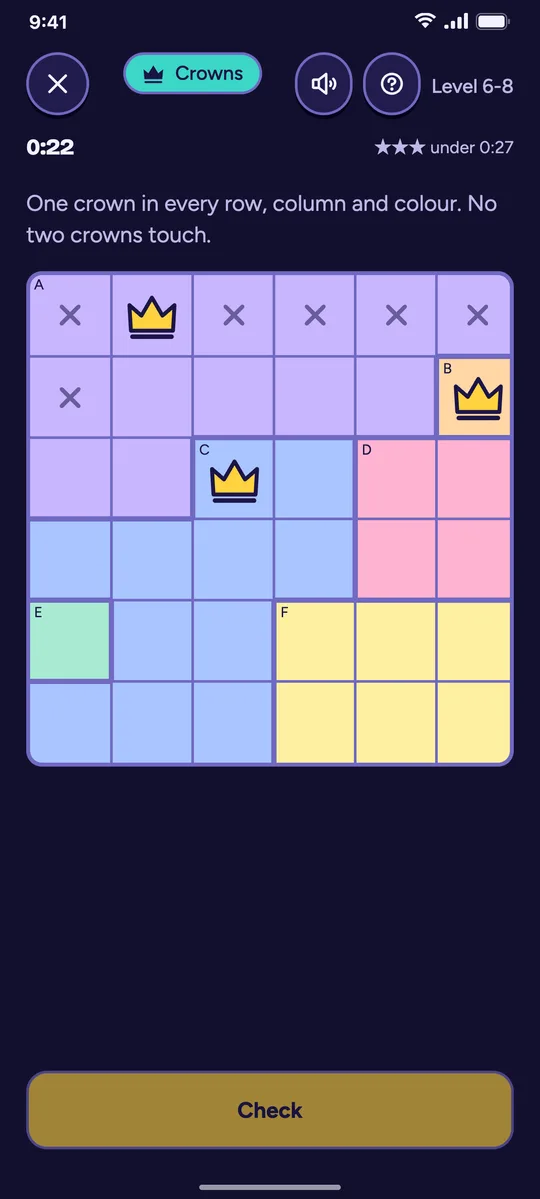
The rules in one minute
You get a square grid cut into coloured regions, as many regions as there are rows. Place one crown in every row, one in every column and one in every region. Two crowns may not touch, and that includes corners.
Two things catch people out. Crowns can share a diagonal as long as they are not neighbours, so this is not the chess queens puzzle. And region borders matter more than the grid lines: the thick lines in the pictures below are where one region ends and the next begins.
The puzzle goes by a few names. LinkedIn’s daily version is called Queens, Knack’s is called Crowns, and puzzle fans know the one-star version as Star Battle. The rules above are the same in all of them.
A worked example, start to finish
This grid is a real 6 by 6 Crowns puzzle from Knack. Rows are numbered 1 to 6 from the top, columns 1 to 6 from the left, and the regions are lettered A to F so you can follow without relying on colour.
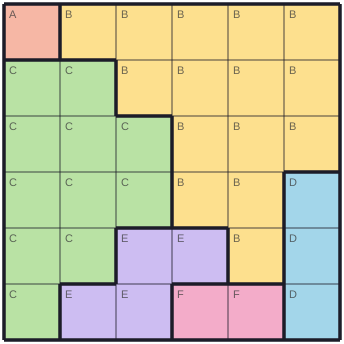
Step 1: begin with the smallest region
Region A is one cell, row 1, column 1. A region with one cell has no choice, so the crown goes there. This is the first thing to look for on every puzzle: a one-cell region, or a region lying in a single row or column.
Step 2: cross out everything the crown rules out
The new crown rules out the rest of row 1, the rest of column 1, and the cells touching it. Mark them with a cross as soon as you place the crown.
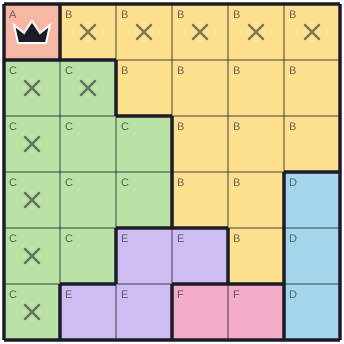
Crossing out is the real work in this puzzle. A crown tells you where one crown goes. A cross tells you where other crowns can never go, and that is what opens the next step. Solvers who only place crowns get stuck early, usually with a grid that has no crosses on it.
Step 3: find a region that fits in one line
Look at region D, the blue strip at the right. All three of its cells are in column 6. So D’s crown has to be in column 6, which means no other region can put a crown anywhere else in column 6. Every yellow cell in that column is out.
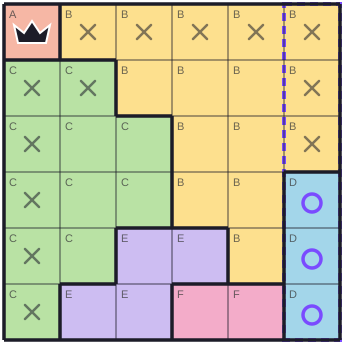
The same idea works in rows. Region F has two cells, both in row 6, so row 6 belongs to F and the rest of that row is out. That empties row 6 for region E, so E must use its cells in row 5, and row 5 becomes E’s as well.
Step 4: let it cascade
With row 5 and row 6 gone, region D has one cell left, row 4, column 6. That crown goes in, and the grid starts to fall quickly: the rest are the only place left in their column or region, one after another.
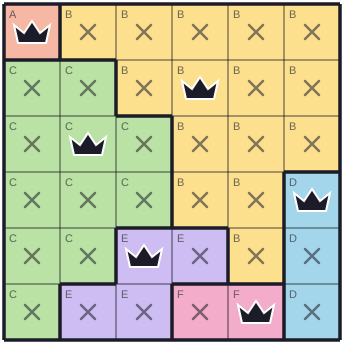
The finished answer, as (row, column): (1,1), (2,4), (3,2), (4,6), (5,3), (6,5). Check it against the rules: one in every row, one in every column, one in each of A to F, and no two next to each other. Rows 3 and 5 have crowns in columns 2 and 3, but they are two rows apart, so they do not touch.
Moves worth learning
These are all the moves the example needed, plus one more for bigger grids.
- Only place left. If a region, row or column has one open cell, the crown goes there.
- A region fits in one line. If every open cell of a region is in one row or column, clear the rest of that line.
- The same thing from the other side. If every open cell of a row is in one region, that region’s crown is in that row, so clear that region’s cells anywhere else.
- Two regions, two lines. If two regions between them fit inside two rows (or two columns), those two lines belong to them and everything else in those lines is out. The same holds for three regions in three lines, though you will rarely need it.
Run through them in that order every time you get stuck. Most stalled grids have one confined region you have not noticed, usually because a cross is missing somewhere.
When you are stuck
We ran the moves above, with no guessing, over 200 generated puzzles of each size on 28 October 2026. They solved 62% of the 4 by 4 grids, 74% of the 5 by 5, 64% of the 6 by 6, 52% of the 7 by 7 and 54% of the 8 by 8. That is a count from our own solver and our own generator, not a rule of the puzzle. A stronger solver, or a person who spots more patterns, will do better.
For the rest, there is one more move: pick a cell in a small region, imagine a crown there, follow every cross it forces, and see whether that leaves some region or line with nowhere to go. If it does, the cell was wrong, and you can cross it out. Every puzzle has exactly one solution, so a wrong guess always shows itself.
If you have not crossed out much yet, do that first. Guessing on an empty grid is the slowest way to solve these.
Mistakes to avoid
- Forgetting corners. Two crowns diagonally next to each other touch.
- Treating it as chess. Only the eight neighbours of a crown are ruled out, not its whole diagonal.
- Placing without crossing out. The crosses are where the information is.
- Reading regions by colour alone. Two regions can look alike, especially two shades of the same hue. Follow the thick borders to be sure where each one ends.
Questions people ask
What are the rules of the Queens puzzle?
Place one crown (queen) in every row, every column and every coloured region. No two crowns may touch, including diagonally at a corner. Two crowns can share a longer diagonal, as long as they are not next to each other.
Is the Queens puzzle the same as Star Battle?
Almost. Queens is essentially the one-star version of Star Battle: one mark per row, column and region, none touching. Star Battle also has harder versions with two stars per line.
Is it the same as the chess queens puzzle?
No. The chess puzzle forbids two queens on any shared row, column or diagonal. Here only the cells right next to a crown are ruled out, and the coloured regions are what make each puzzle unique.
Does every puzzle have exactly one solution?
A well-made one does. Knack's generator checks that every Crowns grid has exactly one solution before it is ever shown to a player.
Do I ever have to guess?
Sometimes, on bigger grids. The moves on this page solved roughly half to three-quarters of the puzzles we tested. For the rest, try a cell, follow what it forces, and undo it if it leads to a clash.
Your Knack rating is for fun. It is not an IQ score, and Knack does not claim to make you smarter.